
The Deep Days
Why Çatalhöyük had no streets
For most of its 1,100 years the world's most famous early town had no streets and no doors at ground level. You came home across the rooftops — and that changes how you picture everything else.
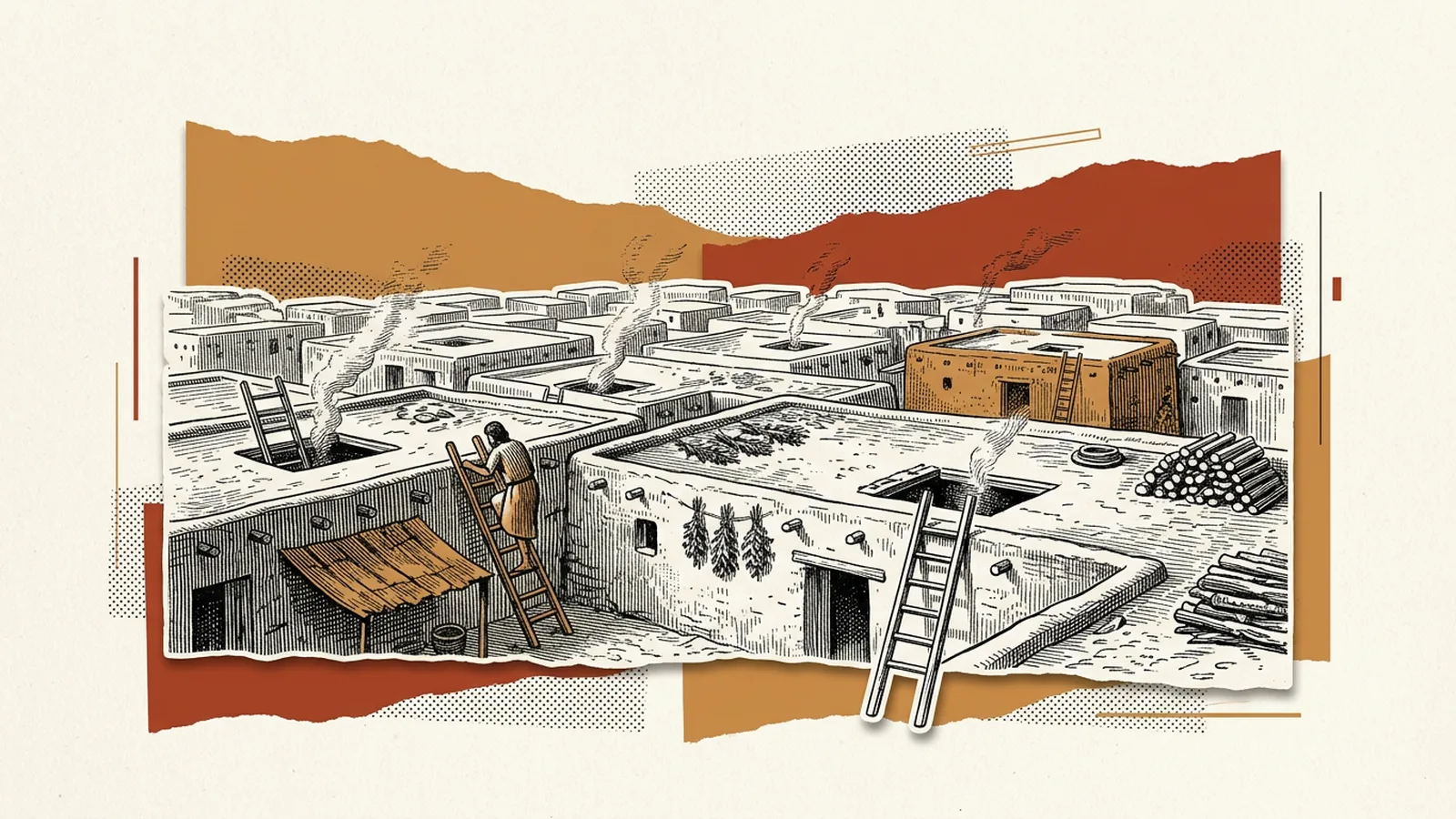
Picture coming home from work. Now remove the street, the front door, and the ground floor. At Çatalhöyük, around 7100 BC, the way home ran across your neighbors’ roofs — and the front door was a hole in the ceiling with a ladder under it.
A town built like a honeycomb
The houses stood wall against wall, packed so tightly that the settlement worked as one continuous surface. The rooftops were the streets: people cooked up there, worked up there, and walked to a neighbor’s house without ever touching the ground. Between house clusters lay middens — refuse areas — not lanes.
What this did to daily life
Entry by ladder changed everything downstream of it. These houses had no windows — light came down the roof opening, and after that from the hearth, the oven and open clay lamps, so interiors stayed dim and smoke-stained. How smoke-stained is now measurable: in 2021 a Newcastle University team burned wood and dung in the reconstructed house standing on the site itself and recorded fine-particulate levels a thousand times over modern WHO guidelines. Three excavated individuals carry black carbon on the inside of their ribs — consistent with breathing that air for a lifetime, though the researchers stop short of calling it proof. Privacy worked vertically: your household was below, the shared world was above. And when a house reached the end of its life, it was carefully filled in and a new one raised on its footprint — the town grew upward through its own history.
When the streets arrived
The streetless plan is the town’s long middle, not the whole of its life. Ian Hodder’s own architectural summary — already cited below — records that Mellaart found evidence of “streets” winding between houses in the upper levels, that recent work has begun to find alleyways bounding sectors of 10–50 houses, and that after Level VI/V the settlement “becomes more dispersed and fragmented. Streets occur and street-level entrances into houses.” In 2021 the excavation’s then-director announced a street in a newly opened area of the North Terrace, adding that only about 6% of the mound has been dug. So the accurate form of the claim is the one UNESCO uses: streetless neighbourhoods, through most of a 1,150-year occupation — not a town that never had a street.
The honest part
Why build this way? Defense is the guess everyone reaches for first, but the excavators themselves hedge: there is no wall, no clear enemy, and the packed plan may simply be how a society of equal households liked to live. We don’t know — here’s the best guess, and that’s how we’ll say it in the film.
Sources
- Çatalhöyük Research Project — Architecture (the excavation's own project page)
- Hodder, I. (2012) "Çatalhöyük. A Summary of Recent Work Concerning Architecture", in Festschrift for Ahmet A. Tırpan, Istanbul: Ege Yayınları, pp. 303–314 — roof access, ladder scars in wall plaster, hearth placement
- Shillito, L-M. et al. (2021) "Analysis of fine particulates from fuel burning in a reconstructed building at Çatalhöyük", Environmental Geochemistry and Health (open access) — PM2.5 measured in the site's own reconstructed house
- Ian Hodder, The Leopard's Tale: Revealing the Mysteries of Çatalhöyük (2006)
- Ali Umut Türkcan (then head of the excavations), 2021 — a street found in a newly opened area of the North Terrace; roughly 6% of the site excavated