The Deep Days
The Skulls Under Çatalhöyük's Vulture Painting Were Never Missing
Çatalhöyük's famous mural shows vultures stripping headless bodies — but the burials directly beneath the painting still have their skulls. A 2016 forensic study on the site's real headless skeletons found a messier story than the wall lets on.
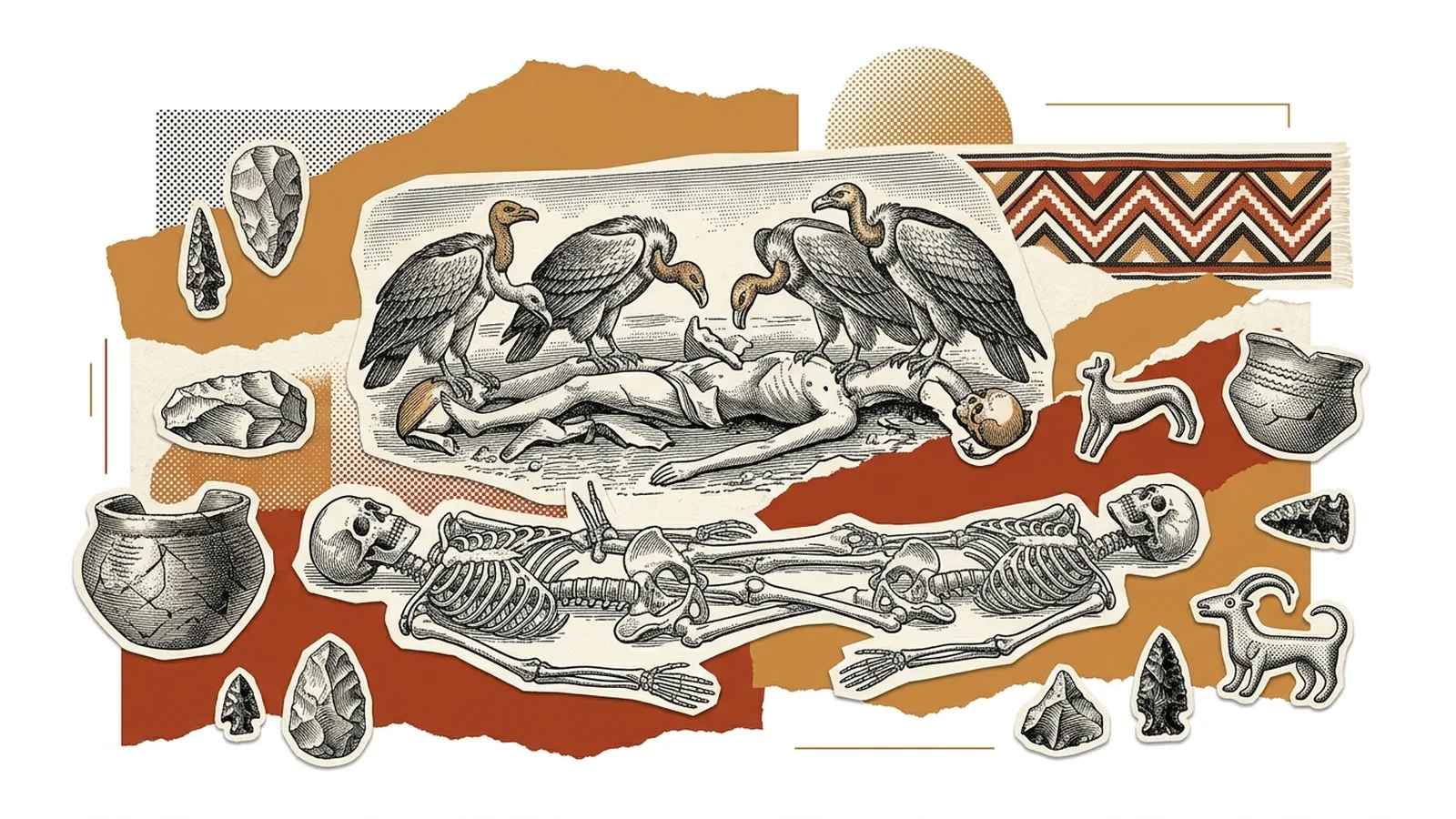
You are standing in a room barely bigger than a modern bathroom, and above the platform where this household buried its dead, someone painted vultures diving on human figures with no heads. This is Çatalhöyük, and this is the deep days: around 7100 BC, in the room excavators would later label Shrine VII.8. For decades it has gone by a simpler name — the Vulture Shrine — and the reading every documentary reaches for first is the obvious one: the birds ate the dead.
Did vultures really deflesh the bodies at Çatalhöyük?
Maybe — but not the way the painting makes it look, and not for the bodies you’d expect. James Mellaart, who excavated Shrine VII.8 in the early 1960s, also found griffon vulture skulls pressed deliberately into plastered, breast-shaped knobs on the walls of several houses at the site, and read the mural as a record of literal practice: vultures called in to strip the dead before burial. It’s a striking idea, even a comforting one — no fear of simply rotting in the ground, just birds doing what needed doing. But when researchers went back decades later to check the evidence Mellaart didn’t have — the bones themselves — the picture got messier, not clearer.
The bodies under the painting still have their heads
Here’s the detail most retellings skip. By the excavation record itself, and by archaeologist Diane Gifford-Gonzalez’s later academic reading of it, the burials actually excavated beneath the Vulture Shrine’s own platform were not headless. They were ordinary interments — skulls in place, laid under the north and east platforms the way most households at the site buried their own. Mellaart counted seven vultures in the scene, painted red, talons picked out, diving on six human figures without heads. Whatever that painting is doing, it isn’t a caption for the graves underneath it.
So whose heads were actually missing?
Real ones — just scattered through other buildings, not this room. In 2016, Marin Pilloud (University of Nevada, Reno), working with Scott Haddow and Christopher Knüsel of the Université de Bordeaux and Clark Larsen of Ohio State, went looking for the forensic signature vultures should leave on bone: puncture marks, scoring, disturbed joints. They examined a sample of skeletons from across the site that were missing their skulls and jawbones — fourteen in total.
Only one showed cut marks consistent with a blade, the kind of evidence you’d expect from a person deliberately removing a head. The other thirteen carried no clear marks either way. That silence cuts both directions: forensic work on how griffon vultures actually feed shows they can strip a body to bone within hours while leaving few or no marks on the skeleton underneath. Unmarked bone isn’t proof the vultures did it. It just isn’t proof anyone else did.
What thirteen unmarked skeletons actually prove
Less than the mural promises, and the researchers say so plainly. Their own conclusion is cautious: vulture excarnation remains a live, plausible explanation — possibly one of the earliest suspected cases of the practice anywhere — but the painting can’t be read as a documentary record of it. The imagery, the embedded skulls, and the genuinely headless dead are three real things that clearly meant something to each other inside this community. They just don’t chain into one provable sequence: body on the roof, vultures called in, clean bones buried below. That sequence is still the best guess on the table. No study since 2016 has closed the gap.
Stand in that room today and you’re standing inside both stories at once — the one painted on the wall, and the one still waiting under the floor.
The Dig
The receipts: Mellaart’s original excavation of Shrine VII.8, within Çatalhöyük’s radiocarbon window of roughly 7100–5950 BC; the griffon vulture skulls he recorded embedded in plastered wall knobs across several houses; and the 2016 re-assessment by Pilloud, Haddow, Knüsel and Larsen in the Journal of Archaeological Science: Reports, which examined fourteen headless skeletons and found blade cut marks on exactly one. No follow-up study has closed that gap since — so we won’t pretend to either.
Same species. Different Tuesday.
Sources
- Forbes coverage of the 2016 Pilloud et al. bioarchaeological re-assessment (verified this cycle)
- ScienceAlert coverage giving the 14-skeleton sample and the single-cutmark detail (verified this cycle)
- Cambridge Core listing for Gifford-Gonzalez (2007), 'On beasts in breasts: another reading of women, wildness and danger at Çatalhöyük,' Archaeological Dialogues (author/journal/year verified this cycle)
- Pilloud, M.A., Haddow, S.D., Knüsel, C.J. & Larsen, C.S. (2016) 'A bioarchaeological and forensic re-assessment of vulture defleshing and mortuary practices at Neolithic Çatalhöyük', Journal of Archaeological Science: Reports 10: 735–743